
English| EUR
Suggested for you
More currencies
Choose a language
Every year thousands of travellers leave Antigua for the La Soledad Trailhead without a clear sense of what the mountain asks of them. This page sets out honestly what the climb demands — the gradient, the volcanic ground underfoot, the cold, the thin air — and who tends to cope well with it. Read it before you book, not after.
Quick answer
The acatenango overnight hike difficulty is best described as strenuous but non-technical: no ropes, no scrambling, just a sustained uphill grind on loose volcanic sand and ash. Standard group departures leave in the 08:00–09:00 arrival window from La Soledad. Fitness matters less than pacing; the altitude gain, not the distance, is what defeats most people.
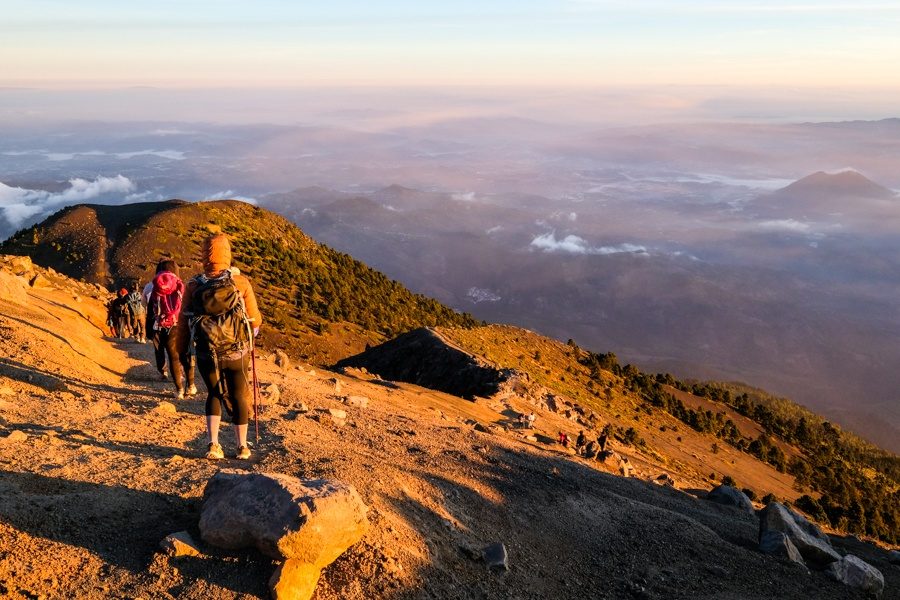
Acatenango's summit sits above 3,970 metres, which places its upper slopes higher than any peak in the continental United States east of the Rockies — and yet the trail requires no climbing skill whatsoever. That contradiction is the whole story of the acatenango overnight hike difficulty. The route is a walking route from start to finish. What makes it punishing is that it almost never stops going up, and it does so through four distinct ecological zones: farmed maize terraces, cloud forest, alpine forest, and finally bare volcanic scree. The ground itself deserves explanation. Much of the lower ascent crosses fine volcanic sand that slides backward underfoot, so a portion of every stride is simply lost. Hikers describe this as walking up a down escalator. Above the treeline the surface turns to ash and lapilli, and the wind arrives with nothing to break it. Overnight temperatures at the high camps regularly fall to near freezing, and the pre-dawn push toward the crater rim — optional at most camps — is the coldest, thinnest, steepest hour of the trip. Across the valley, Volcán de Fuego erupts every fifteen to twenty minutes, which is why people endure any of it. This is why a difficulty rating alone misleads. Trail-fit hikers who bolt up the first hour frequently struggle by the third; slower, steadier walkers who have never trained often arrive at camp comfortable. Guides on the La Soledad route consistently identify pacing, hydration and acclimatisation as stronger predictors of success than gym conditioning. Anyone arriving straight from sea level with a single night in Antigua is asking more of their body than someone who has spent three or four days around Lake Atitlán first. Used properly, an understanding of the acatenango volcano trek difficulty becomes a planning tool rather than a deterrent. It tells you which departure to choose, whether to hire a porter for your pack — an option on nearly every organised Acatenango overnight trek — and how honest to be about your own condition when a guide asks. It also tells you when not to go: heavy rain in the wet months turns the ash to a slick, miserable slurry, and visibility at the summit vanishes. The rest of this acatenango overnight hike difficulty guide breaks the practical pieces apart. Timings and stage-by-stage effort sit in the itinerary section, kit in the checklist, altitude in the common-mistakes section, and transport to the trailhead in its own section below.
“Fitness decides how fast you climb Acatenango; pacing decides whether you finish it.”
This plan suits reasonably fit hikers with no prior altitude experience who want to know what the two days actually demand: roughly 24 hours door to door, including about 5–6 hours of climbing on day one and 15 hours above 3,000 m.
The standard group departure window for coordinated overnight treks. Expect 45–60 minutes of registration, guide briefing and load-sharing before anyone starts walking.
The trail climbs immediately through loose volcanic soil and maize fields at around 2,400 m, gaining 300–400 m in the first hour. This opening stretch is where most people discover their pace is too fast.
Two hours of continuous gradient through dense forest, with short breaks roughly every 45 minutes. Footing improves but the incline rarely eases below 20 percent.
The forest thins near 3,300 m and the air noticeably thins with it. Progress slows to 1.5–2 km per hour here even for strong walkers.
Arrival after 5–6 hours of climbing and roughly 1,300 m of elevation gain. The rest of the afternoon is genuine recovery time, not sightseeing.
A short walk from camp to watch eruptions across the saddle. Temperatures drop below freezing after dark and stay there.
A 1.5-hour climb over loose scree to the 3,976 m crater rim, the hardest 400 m of the trip. Skipping it is a reasonable choice and costs you nothing on the descent.
Two to three hours down, faster but harder on knees and ankles than the ascent. Most groups are back at La Soledad by late morning.
Most people who struggle on Acatenango are not unfit — they have simply misjudged altitude, pace, or the temperature swing between the trailhead and basecamp. These are the errors that turn a manageable trek into a difficult one.
Treating 3,976m as just a long uphill walk
Altitude is the main difficulty factor: basecamp sits around 3,600m, high enough for headaches, nausea and poor sleep. Spend at least one night in Antigua (1,530m) beforehand and drink 3-4 litres of water the day before you climb.
Charging up the steep first hour to stay ahead
The initial farmland section is the steepest and hottest, and burning energy there causes most turnarounds. Set a pace slow enough to hold a conversation and let faster hikers pass.
Ignoring early altitude symptoms and pushing on
Persistent headache, vomiting or dizziness that worsens with height means descending, not resting. Tell your guide at the first sign rather than at basecamp — descent is the only reliable fix.
Dressing for the heat you feel at the start
The trailhead can be 25°C while basecamp drops near freezing after dark. Layer down as you climb and add layers immediately on arrival, before you cool off and start shivering.
Arriving late and missing the group departure
Groups leave in the 08:00–09:00 window. Turning up after it means either hiking the steepest stretch in midday heat or losing the day entirely.
Skipping food and water because of nausea
Appetite drops with altitude, which then worsens fatigue. Eat small amounts often and keep sipping water even when you do not feel like it.
Preparation for Acatenango is mostly conditioning and cold-weather gear, and both take weeks rather than days to sort out.
The trailhead for the Acatenango overnight hike is located at La Soledad Trailhead, Acatenango, Guatemala. Most visitors reach this starting point via organized transport from Antigua.
RN-14 to Parramos then local roads to La Soledad
Shuttle from Antigua to La Soledad
Private transfer from Antigua to La Soledad
The best arrival window is 08:00–09:00, which aligns with the standard group departure window for coordinated overnight treks.
The La Soledad trailhead remains accessible throughout the week to accommodate overnight trekking schedules. Visitors may access the trail at any time as operations run on a continuous basis.
Everything you need to know about acatenango overnight hike difficulty
The acatenango overnight hike difficulty is primarily driven by the significant gain in elevation and the steep volcanic terrain. Hikers ascend from the La Soledad trailhead to base camp, which requires steady physical exertion over several hours.
While previous experience helps, the trek is considered challenging rather than strictly technical. Participants must be prepared for steep paths and the effects of high altitude throughout the climb.
Key factors include your personal fitness level, the steepness of the volcanic slopes, and the weight of your backpack. Most travelers find that managing the incline while navigating loose scree significantly impacts the acatenango overnight hike difficulty.
Consistent cardiovascular training and leg strengthening exercises in the months prior will assist with the climb. Focus on endurance activities to ensure you are comfortable moving at a steady pace for extended periods.
Due to the demanding nature of the route and navigation requirements, most hikers choose to join a guided expedition. Professional guides manage logistics and safety, allowing you to focus on the challenging ascent.
Rapidly changing conditions on the mountain can make the trail more slippery or tiring. It is important to monitor weather forecasts and ensure you have proper footwear to handle the varying terrain safely.